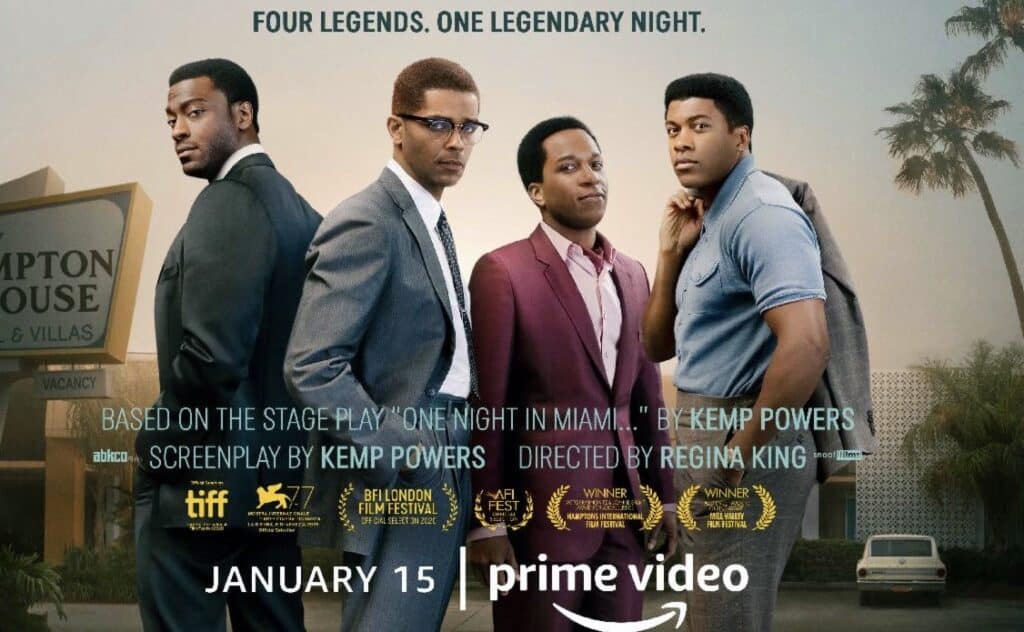
On the evening of February 25, 1964, four icons of sports, entertainment and activism celebrated one of the greatest upsets in boxing history in a modest motel room in Miami. After claiming the World Heavyweight title for the first time, Cassius Clay (Eli Goree) — who would soon change his name to Muhammad Ali — got together with three friends: human rights activist Malcolm X (Kingsley Ben-Adir), music superstar Sam Cooke (Leslie Odom Jr.) and football legend and emerging action-movie hero Jim Brown (Aldis Hodge).
One Night In Miami… is a fictional imagining of the historic night these towering figures spent together. Unbeknownst to the others, Malcolm X, who is about to embark on a bold new undertaking that will put him in grave personal danger, has arranged the gathering in the hope of winning Clay’s support. As the evening progresses in surprising ways, the four men engage in passionate debate about their roles as celebrities and leaders at a pivotal moment in the Civil Rights Movement.
Directed by Regina King and written by Kemp Powers based on his award-winning play, One Night In Miami… is set on the precipice of the momentous political and cultural upheaval of the 1960s. More than 50 years later, these trailblazers’ conversations — about racial injustice, what it means to be successful as a person of color and the social responsibilities that come with that success — still resonate.
One Night In Miami… also stars Joaquina Kalukango, Nicolette Robinson, Beau Bridges and Lance Reddick. The producers are Jess Wu Calder, Keith Calder and Jody Klein. Executive producers are Regina King, Kemp Powers, Paul O. Davis and Chris Harding. The director of photography is Tami Reiker. Production design is by Barry Robison. Costume designer is Francine Jamison-Tanchuck. The film is edited by Tariq Anwar. Music is by Terence Blanchard.
2
ABOUT THE PRODUCTION
The idea for his play “One Night In Miami…” came to Kemp Powers when he learned that after Cassius Clay’s first defeat of Sonny Liston, the 22-year-old Clay went back to the Hampton House Motel in Overtown, Florida — an oasis for African Americans visiting segregated Miami — where he spent an evening in conversation with friends Malcolm X, Sam Cooke and Jim Brown.
“It was just one paragraph in a book I was reading about the intersection of sports and the Civil Rights Movement, but it kind of blew my mind,” recalls Powers. “I had to go back and read it a few more times. And then I couldn’t get it out of my mind. After all, these were four of my heroes.”
Powers says he became obsessed with learning everything he could about how these four men knew each other and why they converged in Malcolm X’s motel room that night. He read multiple biographies and dug up interviews to understand who they were and what their connection was. “The more I learned about them, the more it seemed natural they would have been drawn to one another. They were unapologetic in their art. They were unapologetic in their political beliefs. And in the early 1960s to be a free, unapologetic Black man was quite a rarity.”
The writer imagined the intense conversation the four trailblazers might have had about the issues facing artists and athletes of color — a conversation that young people have had for generations and one that remains relevant today. “The debate they engage in during the play is actually the same debate I would have in my dormitory with my friends when I was attending Howard University,” he says. “What are my social responsibilities? Can I just be an athlete? Can I just be a singer? Can I just be an artist? Why do I always have to be a Black artist? Should I embrace that or try to move away from it? I’m sure there’s a group of teenagers and young adults of color in a dorm room having that debate right now.”
On March 8, 1964, less than two weeks after Malcolm X welcomed the others to his room at the Hampton House, he announced that he was leaving the Nation of Islam, of which he had been a prominent member for more than a decade, and converting to Sunni Islam. He also announced plans to organize a Black nationalist group of his own and to collaborate with other civils rights leaders — something that had been opposed by Nation of Islam leader Elijah Muhammad — all of which he knew would make him a target of his former associates. In Powers’ narrative, Malcolm X has planned the evening in part to convince Clay to join him in leaving the Nation and to throw the considerable weight of his support behind the new movement.
“One Night In Miami…” premiered on stage at the Rogue Machine Theatre in Los Angeles in June 2013. The production garnered three Los Angeles Drama Critics Circle Awards and four NAACP Theatre Awards; Powers was awarded the Critics Circle’s Ted Schmitt Award for Outstanding World Premiere of a New Play.
3
It was after seeing one of those performances that music executive and film producer Jody Klein decided he wanted to get involved with the play. “I met with Kemp and we hit it off right from the start and we decided to work together,” says Klein, who served as a producer of both the play and the film.
Snoot Entertainment’s Keith Calder and his producing partner and wife, Jess Wu Calder, also saw “One Night In Miami…” during its run at the Rogue. “We caught one of the last performances and we were just really blown away,” says Keith. “We knew immediately it could be a wonderful movie. We tracked down Kemp to pitch him on the idea. He and Jody Klein were both excited about the idea and Jess and I convinced them we were the right partners for the project.”
“It was so powerful,” adds Jess Wu Calder. “It touched our hearts and our souls. We felt compelled to translate that power to the screen to reach an even wider audience.”
The Dream Director
With Powers signed on to write the screenplay and serve as an executive producer, the team began searching for the right director for the project. In 2019, Regina King won an Oscar® and a Golden Globe® for her performance in Barry Jenkins’ adaptation of the James Baldwin novel If Beale Street Could Talk. It was the actress’ memorable appearance at the Golden Globes that brought King to the Calders’ attention. “We were just blown away by her acceptance speech,” says Keith. “We started reading more about Regina’s work as a television director and quickly realized that she was the dream pick.”
King had helmed more than 15 episodes of such acclaimed series as “This Is Us,” “Shameless” and “Insecure” as well as the telefilm “The Finest” and was looking for a suitable project to take on as her feature directorial debut. “My agent asked me what types of story I wanted to tell and I said I would love to do a love story with a Black couple as the heroes, set against a real-life historical event,” she recalls. “He brought me One Night In Miami… and while it isn’t a conventional love story, it had the historical and cultural elements I was looking for. And then when I read it, the dialogue Kemp wrote just punched me in the gut. Because I’ve had these conversations, my family and friends have had these conversations, and I know these conversations were going on long before I was even born.”
As a renowned actor herself, King was also drawn to the idea of directing a film centered almost entirely on four dynamic, very different characters interacting over a single night. “It’s an actor’s piece and I felt like the right actors could just make a meal of it and get to exercise everything they’ve worked on to become the actors they are in that moment. I didn’t know who would play the roles at that point, but I knew it was going to have to be four powerhouses.”
King’s passion for the project was immediately evident when she met with the producers, says Klein. “Within five minutes of sitting down we knew we had our director because of her sensitivity to and her understanding of the subject matter,” says Klein. “The story struck a personal chord with her and she was able to articulate that right away.”
4
The play’s resonance for King had a lot to do with the parallels between what was going on in 1964 and what’s happening today. “Obviously, the conversation is still going on about the need to stand up and speak out when so much of what Dr. King and Malcolm X were speaking, writing and preaching about still hasn’t changed,” she observes.
As soon as King joined the project, she and Powers began discussing the adaptation of his award- winning stage work for the screen. At the time, she was on set in Atlanta filming her Emmy®-winning role in “Watchmen” while Kemp was in Oakland co-directing the Pixar animated feature Soul, which he also co- wrote. “We had these Skype conversations about some of the things I felt he had captured that were most important and that I wanted to push further,” says the director. “One of those things was the vulnerability and strength that Black men have, which is something we don’t normally see in film.”
Casting the Legends
Casting a film centered on not just real people but modern legends posed a significant challenge for the filmmakers. “We’re talking about probably four of the most iconic men in the world, especially when you talk about Muhammad Ali and Malcolm X — and even Sam Cooke, whose music really transcends race and color and language,” observes King. “So the audience knows so much about these four men that they are ready to cancel you out if you get it wrong.”
Malcolm X was perhaps the most difficult role to cast, because it required an actor who could portray the intensely serious public-facing persona that audiences are familiar with as well as the humor and tenderness he shares with his wife and close friends in the film. The character is facing a huge personal, spiritual and political conflict as he solidifies his bold plans to split with the Nation of Islam, knowing it could put him and his family at risk. Having inspired Clay to join the Nation of Islam, he now hopes to persuade the charismatic, newly crowned heavyweight champ to leave with him.
King found her Malcolm X in British actor Kingsley Ben-Adir, whose recent credits include recurring roles in “Peaky Blinders,” “The OA” and “High Fidelity” as well as a turn as President Barack Obama in Showtime’s miniseries “The Comey Rule.”
The director says some actors shied away from the role because they feared comparisons to Denzel Washington’s Oscar-nominated performance in the 1992 biopic Malcolm X. “But Kingsley embraced this as an opportunity to tell this story with a perspective that is different than the one presented in The Autobiography of Malcolm X. He plays a Malcolm we haven’t seen before. We forget that he’s a father. A lot of us didn’t know that Malcolm laughed, that he was a bit of a jokester, and Kingsley did all this research and applied those little nuggets that he picked up.”
Powers was deeply impressed by Ben-Adir’s transformation. “Watching Kingsley become Malcolm X has been awe-inspiring for me,” says the screenwriter. “He brought so much depth to this part. His performance is going to be one of the big surprises of the film.”
5
Ben-Adir says he got a last-minute call from his agent about the audition. “I heard about it on a Thursday and they wanted the tape by Friday,” recalls the actor. “I called Jody and said I can read something off a page but I’d really like the weekend at least to give some respect to this and spend a little more time on it — after all this is Malcolm!”
After the producers agreed to the Monday deadline, Ben-Adir spent the weekend holed up listening to the late civil rights leader’s speeches. “At the same time I was looking at the scenes in the script and trying to link them and find a way to make it feel truthful and real,” he says.
Much of what plays out in the film is driven by Malcolm X, notes Leslie Odom Jr., who plays Cooke. “Malcolm seems to have a planned agenda for that night unbeknownst to the rest of us,” he says. “We think it’s to celebrate Cassius’ victory, but when we get there that turns out not to be the case. If we didn’t have the right Malcolm, somebody who knows how to lead a thing like this, it would have fallen apart. Kingsley really set us up for success.”
Eli Goree is a dead ringer for the young Cassius Clay, who announced his name change to Muhammad Ali less than two weeks after winning the Liston fight. “The resemblance is almost uncanny,” says Powers. “On the first day of his audition he came in basically in character. Before he even started reading any lines, he was talking to all of us as though he were Clay. When he turns on all the wit and charm, it’s like he’s channeling Clay. But more importantly, when he’s not turning it on, he can flip the switch and go to this very different, introspective place.”
Goree’s previous roles include the fictional boxer Munroe “Mad Dog” Moore on the hit series “Riverdale” and real-life quarterback Quincy Carter on “Ballers.” Sounding a lot like his boastful character, Goree says with a sly grin, “I went in and saw Regina. She tried to act like she wasn’t super impressed. She tried to like play it cool. But I knew there’s nobody that looks more like Clay, sounds more like Clay, or that’s been boxing for two years like me. I don’t care where you go, you aren’t going to find somebody like that.”
Goree’s portrayal goes far beyond mimicry, says Odom. “There’s a spiritual connection he feels with the man. He brings years of preparation to the role and there’s something he shares in this sort of childlike, good-natured, good-hearted fun that Clay had. Some of the most astonishing scenes with Eli are off-script moments when Regina just let him go.”
In One Night In Miami… the actor had to do more than look and talk like Clay, however. He also had to learn to capture the heavyweight champ’s mannerisms in the ring. “Once we made the decision to cast Eli, the next step was to get him to the point of being able to convincingly fight like Cassius Clay,” says Keith Calder. He had a head start because of his “Riverdale” role, but emulating Clay’s unique boxing style wasn’t easy. “He was a very non-traditional fighter. His guard was usually down. He would almost dance in the ring. Eli had to go to Cassius Clay school.”
6
Goree trained with supervising stunt coordinator Clayton Barber and stunt coordinator Larnell Stovall, both of whom had worked on the hit boxing movie Creed. “Eli had some boxing experience but he had to switch how he holds his hands, his body language, his footwork, his rhythm and adopt the braggadocios attitude that Clay had,” says Stovall. “He was a quick study when it came to learning how to deliver the proper punches, how to sell it for the camera in the style of Cassius Clay. But he was so passionate about getting it exactly right that he kept constantly rehearsing even on his days off.”
According to director of photography Tami Reiker, the fight sequences were filmed using handheld cameras to capture the energy and movement in the ring. “We wanted the audience to feel like they were in the ring with Cassius Clay,” she says.
The boxing scenes also required more than 200 extras to emulate the crowd that watched the match at Miami Beach’s Convention Hall. In addition to the challenge of getting the background actors into period hair, makeup and costumes and then transporting them to the set, King often had to redirect the extras’ enthusiasm during the bout. “Eli was so entertaining that frequently the extras would be cheering for him when in reality the crowd should have been booing Cassius Clay,” King laughs.
Aldis Hodge was selected to portray Cleveland Browns fullback Jim Brown. Considered by many to be the greatest football player of all time, Brown was nearing the end of his sports career in 1964 and embarking on a successful career as an actor.
King says one of Hodge’s gifts to the role of the sometimes intimidating athlete was his calmness. “Jim Brown was not a man you messed with,” observes the director. “Aldis has a tranquility and he understood that quiet strength that Jim has. He wanted to convey Jim’s patience during these conversations where Sam and Cassius are going at it and he’s just the ultimate big brother — like, ‘Oh, you two.’”
Goree describes Hodge as a consummate professional. “He’s always on time, always knows his lines, always knows where he is in relation to the camera,” he says. “Sometimes he’d get mad at me because I don’t always know where I’m supposed to be on the eye lines. He’d be like, ‘You got to move five feet this way.’ He’s just a very experienced, very classy, hardworking guy. That correlates very well to Jim Brown.”
Hodge was unaware of the historic encounter dramatized in One Night In Miami… until he read the script. “Once I knew about it, I knew I had to get this part and I worked very hard at it,” says the actor. “I love that we get to see this powerful moment where these four mavericks are making pivotal transitions that have affected all of us in ways we may not even realize. And it’s so special because we get to see the real camaraderie and brotherhood between them.”
In order to embody the stature of the NFL great, Hodge put in long hours in the gym, adding muscle and weight to his six-foot-one frame. “Aldis is physically imposing, but also really warm and friendly, incredibly intelligent, and incredibly handsome,” says Powers, who has long been a fan of the actor, including his performances in Straight Outta Compton and the recent drama Brian Banks. “He was a shoo-in to play Jim Brown.”
To gain insights into his character, Hodge studied interviews Brown did around the time the film takes place. “In terms of political and personal views, I wanted to stick to that time frame because he’s in a different mindset today,” says the actor. “I’m 33. I didn’t know that Jim back in the day and I want my generation and the younger generation after me to understand that man as well as the icon we know today. Telling a piece of his legacy is a real honor for me.”
Hodge’s favorite interview, one he said he has watched over and over, was an appearance on “The Dick Cavett Show” during which Brown engaged in a debate with segregationist Georgia Gov. Lester Maddox. “Jim Brown and Lester Maddox are going back and forth about cultural issues and the way Jim maintains his candor as Maddox gets angrier and angrier is just so smooth and so cool. He shuts Lester down with his eloquence, cool temperament and intelligence to the point where Lester gets so mad he storms off the stage. Jim knew his stuff and he was speaking from a point of equality. So, for me, this is a man who understood the full picture.”
Odom, who won both a Tony® and a Grammy® for his starring role as Aaron Burr in the Broadway blockbuster “Hamilton,” was always the filmmakers’ first choice to play singer, songwriter and entrepreneur Sam Cooke, according to Keith Calder. But because of potential scheduling conflicts it initially seemed as though it wasn’t going to happen. “We went through a normal casting process of looking at people,” says the producer. “But the whole time we just wanted it to be Leslie. Fortunately he eventually became available for our time frame. The way he worked so hard at capturing Sam’s singing, swagger and whole spirit was unbelievable.”
Odom acknowledges that portraying Cooke, as well as singing several of the songs he wrote or made famous, was a huge challenge. “Those were some big shoes to fill,” he says. “I have such respect and admiration and awe for his talent and what he was able to achieve.”
The singer and actor captures both the charm and the passion Cooke brought to his music and business, says King. “We so often hear Sam Cooke and think of the love songs, but there’s a fire that Sam had and Leslie possesses that as well.”
Before filming began, Odom went into the studio to record several Cooke songs that are heard throughout the film, including during the scene in which Malcolm X chides Cooke for such romantic pop hits as “(I Love You) for Sentimental Reasons” and “You Send Me.” “People think that’s Sam Cooke singing on those needle-drops but it’s actually Leslie,” says King. “I was so grateful I got to be with him in the studio when he laid down those tracks. He’s such a perfectionist and he kept wanting to do it over because Sam has more of a raspiness in his voice and Leslie has more of that smooth Nat King Cole thing going on. Watching him shed his natural style to adopt Sam’s was such a treat.”
8
King says that for her, the key to eliciting the best performances from actors is getting to know them each individually and understanding the best style of communication for him or her. “The ways I communicated with Kingsley or Eli or Aldis or Leslie were all totally different because they are all different men and different actors. They’re all great, but they’ve each had different experiences and journeys that have led them to this moment. Being sensitive to that is very important in my opinion.”
A Change Is Still Coming
Sam Cooke’s song “A Change Is Gonna Come” emerged as a civil rights anthem after its release in 1964 and has taken on renewed significance in the midst of the Black Lives Matter protests of 2020. “‘A Change Is Gonna Come’ remains a powerhouse hit today because we are still waiting on a change to come,” says Hodge. “Sam Cooke was speaking directly to what we dealt with then and, of course, what we’re still dealing with today.”
Cooke performed the song live on-camera only once, on “The Tonight Show Starring Johnny Carson.” Although the tape of that show has been lost, the performance was recreated for the film with Odom at the microphone. “The entire set went quiet when Leslie started singing the song for that scene,” says Klein. “When he finished, people were in tears.”
Producer Jess Wu Calder says Cooke’s song has become a cross-generational touchstone in the ongoing fight for racial justice. “Sam is counting on us to finish what he started. This movie is about passing the baton from generations past to today’s generation. We are saying, ‘We can’t wait for change anymore. We need to make that change happen now.’”
Powers says he’s hopeful a time will come when the song doesn’t resonate so deeply with him and other people of color. “I’m looking forward to the day when this story is a relic in a time capsule and not something that’s speaking to issues we’re dealing with in our current society,” he says. “That day hasn’t come yet and until that day does come, the song is always going to be inspirational to people.”
King has often used her media platform as a widely respected artist to speak out about issues of social injustice and racial and gender inequality. On One Night In Miami… she was able to directly effect change by hiring women and people of color for key production positions. “There are so many artists who aren’t getting an opportunity to work because of how they were born,” she says. “If I am in a position to create an opportunity for someone who qualifies for it but normally wouldn’t get it, it is my responsibility to do whatever I can. No one succeeds without someone else providing an opportunity.”
Music of the Night
The One Night In Miami… score, written by Oscar-nominated composer Terence Blanchard,
comprises almost exclusively blues- and gospel-influenced solo piano. “My original approach to scoring this film was with a larger ensemble that dated back to that period,” says Blanchard. “But Regina had this great
idea of just using piano. It took me a while to come around to it but now I think the piano itself effectively creates a historical narration for the film.”
The result is a subtle musical counterpart to the onscreen drama that enhances the emotional content while not competing with the dialogue. “Terence did brilliant composition work with the piano,” says King. “It so strongly supports Kemp’s words and these amazing performances that the instrument seems like a fifth character. A bigger score may have distracted from them a little bit.”
Blanchard enlisted acclaimed jazz pianist Benny Green to perform the score, giving him plenty of room to improvise on the various themes. According to the composer, the use of solo piano prompts viewers to lean in and pay attention to what’s going on with the characters. “There are moments when it is playful, like when Sam pulls up to the hotel. And then there are times when it is more loving, like when Malcolm is speaking to Betty on the pay phone.”
During the scene where Clay and Malcolm X pray together, Blanchard adds another color to the score by introducing a duduk, an ancient Armenian double-reed wind instrument, which returns later in a few key moments.
One Night In Miami… also features the original song “Speak Now,” written by Odom and Sam Ashworth. Sung by Odom, in his natural voice, accompanied by only acoustic guitar, organ and percussion, the song builds from almost a whisper to a rousing call-and-response final chorus. Like the film, “Speak Now,” which plays over the main titles and end credit crawl, is an inspiring call to action that acknowledges the struggles of the past and the present as well as the need to keep working toward a more just future.
It includes the lyrics:
Listen, listen,
To the message of hope in the whispers of ghosts Listen, listen, listen
For the children will grow on the seeds that we sow
“It’s a beautiful song and there’s something about Sam’s lyrics that really embodies what happens in the film in a way that is almost haunting,” says King. “And we all felt like it was great to have a song that did not feel, musically, like the ’60s. We wanted it to feel contemporary because, again, the conversations that take place in the film are contemporary conversations as well.”
Odom and Ashworth had collaborated on several songs in the past, but had never written one for a film. “It was a new experience and level of vulnerability so it helps to take the leap with someone you trust,” Odom says. “We just toss ideas, and melodies, and changes back and forth until we have something we like. It can take a while.”
Odom says “Speak Now” was inevitably influenced by “A Change Is Gonna Come.” “It had to be. I was aware that the next sound the audience was going to hear in the film, after the masterpiece that is ‘Change,’ would be the bars of this song I was going to write. So that was our challenge. Sam imagined that a
10
change was on the way. Almost 60 years later, we had to ask ourselves if it had arrived. And if it had, for whom? It ain’t ‘A Change Is Gonna Come Part 2’ but maybe it can serve as a bridge. Maybe it will encourage the next young prophet or poet. We hoped for something like that.”
Overtown, 1964
Overtown, the location of the Hampton House Motel where the men got together, is a community just northwest of downtown Miami that was established in the late 1800s to accommodate Black laborers. Later it developed into a hotspot of Black culture and entertainment as well as a safe place to spend the night for Black celebrities and other visitors to segregated Miami.
One Night In Miami… was shot in New Orleans in early 2020, but King, Reiker and production designer Barry Robison did intensive research to ensure they captured the look of the South Florida locations depicted in the film. The filmmakers studied archival footage of the Clay-Liston fight and pored over the photographs of Howard Bingham and Neil Leifer as well as of street photographers Saul Leiter and Garry Winogrand.
“There are a lot of iconic pictures that were taken at the Hampton House,” says King, “not only from that night but from other moments in history, including some great photographs of Martin Luther King.”
While striving to convey the feeling of the historic motel as it appeared in 1964, the filmmakers used creative license in building and dressing the interior sets, including increasing the size of the motel room where much of the action takes place. “I felt like if we kept it to the size of the actual room it would become claustrophobic in moments that I didn’t want it to,” says King. “There are definitely moments in the film where I did want it to feel claustrophobic, especially for Malcolm, but I knew we could do that with the camera. Other times I wanted to be able to have the depth the larger room gave us.”
Most of the archival photographs of the hotel were in black and white, which allowed the filmmakers to make creative decisions about the color of the room’s walls and paneling. “But the liberties we took were all leaning into all those things that made the Hampton House the Hampton House and either making them bigger or shifting them in a way that accommodated the story,” says King.
With much of the action taking place in a single motel room, the director was faced with the challenge of maintaining a sense of visual vitality. “It starts with great performances and great dialogue,” says King. “I definitely went into this feeling that the dialogue is the star and I never veered away from that. That said, I had countless conversations with my DP, Tami Reiker, about ways to help it not feel static.”
For King that meant allowing the camera to move enough to create a sense of excitement but not so much that it distracted from the actors and what they are saying. “I always think it’s confusing as an audience member when you’re like, ‘What is the camera doing? Why is it moving?’”
11
To address King’s concerns, Reiker came up with the idea of shooting in the room with the ARRI Alexa 65 large-format camera mounted on a jib arm, essentially a boom with a counterweight that allows the camera to move through an extended arc. “Some parts of the room, including the kitchenette, are actually cutouts,” says King. “We put the camera through those holes and the jib arm allowed us to always be kind of floating and created movement even when we weren’t moving.”
Another way King sought to ramp up the visual interest was through the use of a vibrant and saturated color palette. “If you look at footage from that time period it tends to be a little more muted,” she notes. “But I have a 20-something son and while I didn’t want this to look like a music video, I do know how quickly he and his friends lose attention when color is not popping out at them. I also feel like bold colors represent the history of black people in America. Despite the trials of our past we still have always found a way to laugh, to dance, to sing — and that brings color to mind.”
Visual references King shared with her department heads included paintings by African-American artist Jacob Lawrence, the massive Taschen photo book GOAT: A Tribute to Muhammad Ali and Wong Kar-Wai’s classic 2000 film In the Mood for Love.
King worked with costume designer Francine Tanchuck to ensure the costumes not only captured the fashion of the era, but also conveyed the personal style of each of the four main characters. Accomplishing that was made more challenging by the fact that the men wear the same outfits for most of the film.
“We breathed a huge sigh of relief once we got Francine on board to be our costume designer,” says Keith Calder. “We knew this was going to be a tricky film to get the wardrobe right. We have four men in one space for a long period of time. And those costumes need to be interesting the whole time and embody who they are in a way that you don’t normally have in a film where they’re changing costumes every few scenes.”
After meeting with King to discuss the script and her vision for each character, Tanchuck presented the director with look books for each of the four men. “It was not just a matter of the cut of the clothes,” says the designer. “It also involved details of fabrics, texture, even buttons and how the costumes have to work in regard to actor movement — all with the consideration of recreating and being respectful to these historic figures and that era.”
In addition to doing research online and in books, Tanchuck drew on her own memories of the time. “I remember as a little kid those images of Malcolm X coming on the news,” she says. “And I certainly remember when there was a special news break during one of my dad’s TV shows. That image, which had a certain intensity for me as a child, burned into my brain.”
Tanchuck says her favorite character to design costumes for was Cooke, whose dapper look she also partially recalls from childhood. “My dad played Sam Cooke records when we were little and I remember his album covers and how handsome he was,” she recalls. “I just kept all of that in mind when
12
designing his look — style with just a little bit of progressiveness. It’s just a nice, clean, beautiful style.” For Clay, the designer says she went with a look that defined the public figure he was becoming
in that era. “At that time, he was developing this persona that we would all come to know. He was loud and proud. He was really building his image up and that’s what I tried to capture.”
Tanchuck, who worked with the real Jim Brown on the 1987 film The Running Man, says the football great turned actor has always favored a conservative look. “He wore three-piece suits when he was younger and he still wears them.”
Also essential in defining the actors’ appearance were head of makeup design and prosthetic designer Scott Wheeler, key makeup artist Sabrina Cruz Castro, hair department head Nakoya Yancey and key hair/barber Wayne Jolla Jr. “Early on we had discussions with Regina about how we could use prosthetics and other aspects of makeup to get our actors’ features as close as possible to the original icons without losing what makes our actors so special,” says Keith Calder.
Creating makeup and prosthetics to emulate real-life people adds an additional level of pressure, according to Wheeler. “When you’re doing a likeness makeup, as opposed to a Star Trek alien or old-age makeup, you have an objective reference by which your entire audience will judge your work,” he says. “We have photos to study and use in research but so does the audience. They can take a look at a picture of the actual person at the actual time and do a side-by-side comparison to see what you got right and what you got wrong.”
Part of Wheeler’s task was making prosthetic nose pieces for Hodge as Brown and Odom as Cooke — in a hurry. “From the moment I actually got to meet the actors and do an out-of-kit test makeup to the time that we actually started shooting was about three weeks,” he says. “That entailed quick tests, live casts, a week of shop work to build the prosthetics, making changes based on test notes and then going back over Christmas vacation and rebuilding the prosthetics.”
A Message of Hope
One Night In Miami… was a passion project for everyone involved, according to Klein. “The
dedication Regina, Kemp, the actors and the crew put forward was beyond spectacular. I believe that comes from everyone’s belief that the story of these four legends and their influence on the Civil Rights Movement is still relevant, inspiring and tremendously important today, and that it will motivate the audience to keep fighting for change.”
Odom thinks audiences will first and foremost be entertained by the film. “It’s a fun movie and a good time,” says the actor. “And then at the same time it’s the story of these four intelligent, influential guys, their friendship and the change they brought to what was happening in society. The audience can also expect some emotional sparks to fly.”
The film is unique in that it presents four powerful Black men challenging and supporting one
13
another, says Hodge. “We get to show men who are in different stages of their lives debating, arguing and then figuring out how to come back together and get on the same page and not hold grudges. We see a lot of love, in a very different way, between these men.”
One Night In Miami… is a snapshot of a pivotal moment in African-American history that has far broader implications for society at large, observes Powers. “The story is unapologetically Black, but it’s also universal,” he says. “I don’t think you have to be Black to understand what these men were going through. And I don’t think you have to be a man to understand what they were going through.”
He adds that he hopes the film gives young people fighting for equality today some insight into the roots of the movement. “In some ways I wrote this for my 19-year-old self,” says Powers. “I wish that I had been aware of just how much the Civil Rights Movement and the Black Nationalism movement was a youth movement that was being done by people no older than I was at the time. That’s really important.”
For King, One Night In Miami… is a reminder that despite their mythic status and tremendous achievements, Malcolm X, Cassius Clay, Sam Cooke and Jim Brown were human beings with their own dreams, ambitions, fears and insecurities. “Throughout the process of making this film I realized that in the past I’ve been guilty of looking at them as deities and forgetting to look at them as men first,” says the director. “And it made me realize what a huge amount of pressure that puts on a person, and how incredible it was that they were able to navigate so successfully with all of those expectations put on them.”
14
KEY EVENTS OF THE CIVIL RIGHTS MOVEMENT IN RELATION TO ONE NIGHT IN MIAMI…
August 28, 1955 – Emmett Till, a 14-year-old African American, is lynched in Mississippi after being accused of offending a white woman in her family’s grocery store. His killers were later acquitted.
December 1, 1955 – Rosa Parks is arrested after refusing to give up her seat to a white passenger on a bus in Montgomery, Alabama.
September 4, 1957 – Nine Black students attempting to start classes at all-white Central High School in Little Rock, Arkansas, are met by national guardsmen and a threatening mob.
September 15, 1963 – Four young girls are killed and many other congregants injured when a bomb explodes at the predominantly Black 16th Street Baptist Church in Birmingham, Alabama.
February 25, 1964 – After winning the Heavyweight Championship, Cassius Clay spends an evening with Malcolm X, Sam Cooke and Jim Brown at the Hampton House in Overtown, Florida.
March 6, 1964 – Nation of Islam leader Elijah Muhammad announces Clay has changed his name to Muhammad Ali.
March 8, 1964 – Malcolm X announces his split with the Nation of Islam and his plans to organize a Black nationalist group and collaborate with other civil rights leaders.
July 2, 1964 – President Lyndon B. Johnson signs the Civil Rights Act of 1964.
December 11, 1964 – Sam Cooke is shot and killed in Los Angeles under suspicious circumstances. Hundreds of thousands of fans in L.A. and Chicago take to the streets to mourn his passing.
February 21, 1965 – Malcolm X is assassinated by members of the Nation of Islam.
March 21, 1965 – Two weeks after “Bloody Sunday,” when 600 marchers (including a 25-year-old John Lewis) are attacked by Alabama state troopers at the Edmund Pettis Bridge, Martin Luther King Jr. leads 2,000 protestors on a five-day march from Selma to Montgomery.
August 6, 1965 – Johnson signs the Voting Rights Act of 1965.
April 4, 1968 – King is assassinated in Memphis.
April 28, 1967 – Ali refuses induction into the U.S. military because of his objections to the Vietnam War.
As a result he is stripped of his championship title, banned from boxing and sentenced to five years in
15
prison. Four years later the Supreme Court overturns his conviction in an 8-0 decision.
ABOUT THE LEGENDS
MALCOLM X was an outspoken advocate of racial justice and human rights who is today acknowledged as one of the most influential figures of the 1960s. Born Malcolm Little, he had a troubled upbringing and found himself in prison by the age of 22. There, the teachings of Elijah Muhammad’s Nation of Islam resonated with him and he joined the political and religious movement, adopting the surname X to symbolize the African family name that he could never know.
After his parole in 1952, his power and influence quickly grew and he began establishing temples up and down the East Coast, under the surveillance of a disapproving FBI. In his public speaking, Malcolm X captured the pain and anger of many Black people regarding inequality and his “by any means necessary” approach to racial justice offered a stark contrast to the strategy of nonviolence championed by Dr. Martin Luther King Jr.
In March 1964 Malcolm X announced his break from the Nation of Islam, the culmination of a rift with Muhammad. He converted to the Sunni faith, formed his own religious organization and went on a global speaking tour. He sought to bring the mistreatment of Blacks in the U.S. to the attention of the United Nations as a human rights violation. However, he also indicated that in his travels he found new hope for healing the racial divide.
Upon returning to the U.S. Malcolm X received death threats, and his feud with Muhammad intensified. On Feb. 21, 1965, Malcolm X was shot and killed while preparing to address his followers in a Manhattan ballroom. Three Nation of Islam members were tried and convicted of his murder. Malcolm X left behind a legacy of building Black pride at a critical juncture in history, and King wrote that, despite the men’s differences, he could see in Malcolm X “a capacity for leadership which I could respect, and which was just beginning to mature in judgment and statesmanship.”
CASSIUS CLAY was not only widely acknowledged as the greatest boxer of all time, he was a global ambassador for peace and generosity of spirit. Born and raised in Louisville, Kentucky, Clay began training to become a boxer at the age of 12. By 18 he was a champion, winning a gold medal at the 1960 Summer Olympics and going pro soon thereafter.
Clay attended his first Nation of Islam meeting in 1961 and met Malcolm X the following year. Though he initially kept his conversion to Islam a secret, Clay acknowledged Malcolm X as his spiritual and political mentor. The boxer’s bold and poetic boasts about his prowess in the ring burnished his credentials as much as a 19-0 record as he solidified his status as a title contender. Just 10 days after defeating Sonny Liston in Miami to win the World Heavyweight Championship, Clay changed his name to one of his choosing: Muhammad Ali.
In 1967 Ali refused induction into the U.S. military during the Vietnam War, declaring himself a
16
conscientious objector to the controversial conflict. This statement of protest came at great professional and personal cost. Ali was stripped of his passport and his boxing titles and sentenced to five years in prison. Though his conviction for draft evasion was overturned by the Supreme Court in 1971, Ali was unable to compete professionally from 25 to nearly 29. But the charismatic fighter spent these years speaking at colleges across the nation, advocating Black pride and racial justice to an admiring public. Inspired by the courage of Ali’s convictions, leaders across the spectrum of the Civil Rights Movement came to see him as a unifying force in their struggle for equality.
Ali would regain the Heavyweight Championship twice and became the most recognizable man in the world, an icon of activism, achievement and philanthropy known as “The Greatest.” Though slowed by his diagnosis with Parkinson’s disease in the 1980s, Ali remained an active supporter of humanitarian causes until his death in 2016.
SAM COOKE earned the moniker “King of Soul” for his outsized impact on the musical genre. Inspired by the popular gospel group the Soul Stirrers, Cooke formed his own quintet in his teens before being invited to join the Soul Stirrers, a dream come true. After six years with the group Cooke went solo and his 1957 ballad “You Send Me” hit No. 1 on the charts, knocking Elvis Presley’s “Jailhouse Rock” from the top spot.
Cooke established his own music publishing company in 1959 and his contract with RCA the following year included both a substantial advance and ownership of his master recordings after 30 years. It was a landmark deal for any performer at the time but especially unusual for a Black artist. Cooke’s 1960 hit “Chain Gang” was both a catchy tune and subtle social commentary on the practice of using prison inmates as cheap labor. But it was Cooke’s “A Change Is Gonna Come” that in 1964 became an anthem of the Civil Rights Movement. Inspired by real-life events, including Cooke and his family being turned away from a whites-only motel in Louisiana and subsequently arrested, the song was a painful but ultimately hopeful clarion call.
Cooke’s meteoric career was cut short in December 1964 when he was shot and killed under suspicious circumstances at a Los Angeles area hotel. He did not live to see “A Change Is Gonna Come” earn its place in history as one of the most inspirational songs not only of the Civil Rights Era, but of all time. The song was ranked No. 12 in Rolling Stone’s 2005 list of the 500 Greatest Songs of All Time and in 2008 President-elect Barack Obama referenced Cooke when he told supporters in Chicago, “It’s been a long time coming, but tonight, change has come to America.”
JIM BROWN is widely regarded as the greatest running back to ever play the position, and thought by many to be the best football player of all time. Though he displayed startling aptitude at five sports at New York’s Manhasset Secondary School, Brown was not offered athletic scholarships and it took another player’s
17
injury to get him into the starting lineup of the football team at Syracuse University, where he also starred on the basketball court. In addition he played lacrosse, and in 1983 became the first African American to be enshrined in the Lacrosse Hall of Fame.
Brown was selected sixth in the 1957 NFL Draft by the Cleveland Browns, for whom he set a rookie rushing record of 237 yards in a single game, a record that would stand for 40 years. By 1964 Brown had already led the league in all-purpose yards four times and scored 82 touchdowns. He would lead the Browns to an NFL championship that season and, after playing one more year, retired from football at age 29 to pursue his acting career.
Though Jackie Robinson had officially broken the color line in 1947, most professional sports were still white-dominated in the early 1960s and Brown’s achievements during the height of the Civil Rights Movement made him an inspiring figure for many. He became known as a champion of economic independence for Blacks, intervened in Los Angeles gang wars to stop the killing and help gang members find a better path, and founded several community programs to foster opportunities for minorities.
Brown would also act in more than 50 film and television productions, including an acclaimed turn in Robert Aldrich’s Oscar-winning WWII action film The Dirty Dozen. He won an NAACP Image Award for his performance in 1970’s El Condor opposite Lee Van Cleef and in 100 Rifles Brown appeared with Raquel Welch in the first interracial love scene depicted in a mainstream American film. While he has largely retired from acting, Brown continues his charitable endeavors today.
18
ABOUT THE CAST
KINGSLEY BEN-ADIR (Malcolm X) is a British-Afro Caribbean actor who, after more than a decade of impressive work on stage, film and television, is becoming one of the industry’s most sought-after talents and appears in a number of highly anticipated projects.
Ben-Adir was recently seen playing the role of Barack Obama in Billy Ray’s “The Comey Rule,” starring Jeff Daniels as James Comey and Brendan Gleeson as Donald Trump. Based on the memoir A Higher Loyalty by former director of the FBI Comey, the two-night special premiered on Showtime. Ben- Adir also starred opposite Sarah Snook in “Soulmates,” AMC’s episodic anthology series created by William Bridges and Brett Goldstein. Wryly examining the nature of romantic love, “Soulmates” is set after science has made a discovery that changes the lives of everyone on the planet – a test that unequivocally tells you who your soulmate is.
Ben-Adir can also be seen in the Hulu dramedy series “High Fidelity,” opposite Zoë Kravitz, as well as HBO’s anthology series “Love Life,” produced by Paul Feig and co-starring Anna Kendrick. He previously starred opposite Brit Marling and Jason Isaacs in the second season of the hugely popular Netflix series “The OA.” Additionally, Ben-Adir was a series regular for several seasons of ITV’s drama “Vera,” alongside Brenda Blethyn. He also co-starred alongside Cillian Murphy, Tom Hardy and Helen McCrory in five episodes of the BBC/Netflix’s critically acclaimed series “Peaky Blinders.”
In addition to his work in film and television, Ben-Adir has made a name for himself in the theater realm as well. He played multiple characters in the award-winning U.K. stage production “The Riots,” which focused on the real lives of those involved in the London riots of 2011. He has also performed in “The Westbridge” at the Royal Court and “A Midsummer Night’s Dream” at the Regent’s Park Open Air Theatre; Mark Rylance’s “Much Ado About Nothing” at the Old Vic, starring Vanessa Redgrave and James Earl Jones; and “God’s Property,” at the Soho Theatre.
ELI GOREE (Cassius Clay) starred in Stephen Hopkins’ Race, for which he received a Leo Award for Best Supporting Performance by a Male in a Motion Picture. Goree recently starred in USA’s “Pearson,” opposite Gina Torres, Bethany Joy Lenz and Morgan Spector. The series is the spin-off of the well-loved series “Suits.” Goree can also be seen reprising his role as Mad Dog in Season 4 of CW’s “Riverdale.”
The actor’s other television credits include HBO’s “Ballers,” CW’s “The 100,” “Supernatural” and “Emily Owens, M.D.,” Global TV’s “’Da Kink in My Hair,” CTV’s “Motive,” Netflix’s “GLOW,” Showcase’s “Eve of Destruction” and Freeform’s “Dead of Summer.”
On the lifestyle side, Goree has hosted “The Big Black Rap Show” on the Canadian campus radio station CKDU-FM and was one of the hosts for the last season of the CBC series “Street Cents.” He also worked as a freelance journalist for Canada Now.
19
Born and raised in Halifax, Canada, Goree currently resides in Los Angeles.
ALDIS HODGE (Jim Brown) may be best known for his role as MC Ren in Straight Outta Compton, the NWA biopic that earned nominations for various awards including a 2016 Screen Actors Guild Award (Outstanding Performance by a Cast in a Motion Picture), a 2016 Producers Guild Award and an Academy Award® for Best Original Screenplay. Straight Outta Compton won two African American Film Critics Association Awards (Best Picture and Best Ensemble) and an NAACP Image Award (Outstanding Motion Picture).
More recently Hodge appeared in the hit thriller The Invisible Man, opposite Elisabeth Moss, and co-starred with Alfre Woodard in Clemency, which won the 2019 Sundance Film Festival Grand Jury Prize for Best Dramatic Feature Film. At the 2020 Santa Barbara International Film Festival Hodge won a Virtuoso Award for his work in the film.
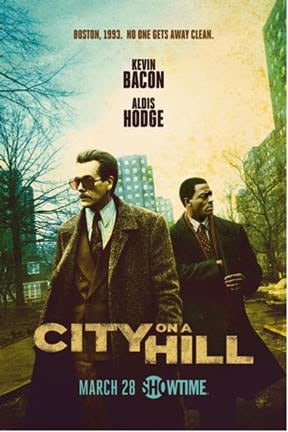
The actor recently wrapped production on TNT’s “Leverage,” where he reprised his guest-starring role as Alec Hardison. Hodge is a series lead alongside Kevin Bacon in Showtime’s “City on a Hill,” produced by Matt Damon, Ben Affleck and Tom Fontana. The show is in its second season.
Previously, Hodge starred in Brian Banks, directed by Tom Shadyac, and What Men Want, opposite Taraji P. Henson and Tracy Morgan. He also appeared in the Academy Award-nominated historical drama Hidden Figures, sharing in the cast’s 2017 SAG Award for Best Ensemble Cast, and starred opposite Tom Cruise in Jack Reacher: Never Go Back. Hodge’s other film credits include Magic Camp, The East and A Good Day to Die Hard.
On the small screen Hodge appeared in the fourth season of the hit Netflix series “Black Mirror” and played the lead in a new Netflix anthology, “Medal of Honor.” He was also seen in the WGN America series “Underground,” opposite Jurnee Smollett-Bell and Christopher Meloni.
Hodge started his career at the age of 3 by working as a model for print ads and commercials, making the transition to the small screen when he and his brother Edwin were cast on “Sesame Street.” Next they joined the Tony Award-winning revival of “Show Boat” on Broadway. Hodge went on to appear in films such as Die Hard with a Vengeance, Bed of Roses, The Stone House, Edmond, The Lady Killers and Big Momma’s House. His early TV work included roles on series such as “Friday Night Lights,” “Supernatural,” “The Walking Dead,” “Girlfriends,” “American Dreams,” “City of Angels,” “Bones,” “CSI,” “ER,” “Cold Case,” “Charmed” and “Boston Public.”
Hodge was born in Jacksonville, North Carolina, raised in New York and currently resides in Los Angeles. In addition to acting, he writes scripts for film and television, designs luxury timepieces and is an avid artist and painter.
LESLIE ODOM JR. (Sam Cooke) is a multifaceted Tony Award®- and Grammy Award®-winning performer whose career spans Broadway, television, film and music. Odom received an Emmy Award® nomination for his work voicing the character of Owen Tillerman in Josh Gad’s new animated musical-comedy series “Central Park,” for Apple TV+. He can also be seen on Disney+ in the filmed performance of the original Broadway production of “Hamilton.” Odom also co-stars in the Freeform limited series “Love in the Time of Corona.”
The actor’s upcoming projects include the feature film Music, written and directed by singer- songwriter Sia, and Needle in a Timestack, written and directed by John Ridley. Next spring he will star in The Many Saints of Newark, a prequel to David Chase’s award-winning HBO series “The Sopranos.” Additional film and television credits include Harriet, Murder on the Orient Express, Only, Red Tails and “Smash.”
Odom made his Broadway debut in “Rent” at the age of 17. He is best known for his breakout role as Aaron Burr in the smash hit Broadway musical “Hamilton,” for which he won the Tony Award for Best Actor in a Musical and a Grammy as a principal soloist on the original cast recording. He also starred opposite Lin-Manuel Miranda and Karen Olivo in a 2014 City Center “Encores!” revival of Jonathan Larson’s “Tick, Tick…Boom!”
In 2017 Odom returned to the New York City stage in a solo concert at Jazz at Lincoln Center. The cabaret-style performance was crafted around signature songs and music that shaped the artist’s journey, all performed with a world-class band in front of a live audience. The show was filmed for broadcast as an hour- long PBS special as part of the 17-time Emmy-winning series “Live From Lincoln Center” and premiered in 2018.
A Grammy-winning recording artist, Odom’s self-titled debut album was part-funded by a successful Kickstarter campaign and released in 2014 by Borderlight Entertainment. In 2016 the album was re-released with additional material and charted at No. 1 on the Billboard jazz chart. In 2017 he re-released his holiday album Simply Christmas as a deluxe edition with new arrangements and new songs and it hit No. 1 on the iTunes and Billboard jazz charts. Last November Odom released his third full-length album and first of original material, entitled Mr.
In 2018 Odom added the title of author to his resume with the release of his book Failing Up: How to Take Risks, Aim Higher and Never Stop Learning. Written in the style of a commencement speech, the book brings together what Odom has learned in life so far, tapping into universal themes of starting something new, following your passions, discovering your own potential and surrounding yourself with the right people. The book was published by Feiwel & Friends, an imprint of Macmillan Publishers.
JOAQUINA KALUKANGO (Betty X Shabazz) recently starred in the critically acclaimed Broadway production of “Slave Play,” for which she received much praise for her incredibly layered and devastating performance. She can currently be seen in Episode 3 of Ava DuVernay’s Netflix series “When They See Us” and has a recurring role on the HBO series “Lovecraft Country.”
Kalukango is a Juilliard grad who was also seen on Broadway as Celie’s (Cynthia Erivo) sister Nettie in “The Color Purple.” Her other stage credits include “Holler If Ya Hear Me” and “Godspell.”
NICOLETTE ROBINSON (Barbara Cooke) plays Sade in Freeform’s limited series “Love in the Time of Corona” and recently starred in “Waitress” on Broadway. She holds the distinction of being the first African-American woman to play the musical’s leading lady. On television Robinson played Jane on Showtime’s Golden Globe Award®-winning drama “The Affair.” She has also appeared on “Hart of Dixie,” “Unforgettable,” “Perfect Couples” and “Cold Case,” among other series.
Robinson is a graduate of UCLA’s School of Theater, Film and Television.